Hey there! The following is an attempt at voicing some thoughts I had for some good amount of time, this is the “first part”, of whatever is deemed to follow it.
Without complicating matters further: These thoughts are inspired by a recently published book: 3 Shades of Blue by James Kaplan. The other part? Insights (if you’ll allow me to arrogantly call them so) that I’ve gathered through the years of being a practicing jazz musician. Let’s begin our small investigation with a quote from the introduction of the mentioned book: “I confess that in the genres of bebop and hard bop, jazz created in the quarter century between, roughly 1942 and 1967, I find almost all of the jazz that I want and need.” I get him, you know. The commercially successful Kind of Blue and My Favorite Things emitted a timeless beauty, a diamond-like durability. They were the reason I got interested in jazz music from a purely artistic and deep viewpoint. I saw some gold there, something precious, and I knew I would want to pursue this—but I had no idea how to (before the Neukölln StuVo times). I would even say some religious feelings (alongside my very steady meditative practices) were invoked, maybe with an idea the famous Dostoyevsky quote points to best: “Beauty will save the world” (spoken by Prince Myshkin in his novel The Idiot). Though we rightfully have to ask ourselves why it must be “The Idiot” who makes the uttering (whoever read the novel has a gut feeling why).
So with this little introduction as a kickoff, let us jump right into the matter. And maybe, just maybe, along the way we’ll answer the strange and impossible question: What is this jazz?
To use anything outside of the body (and your limbs, too, for that matter), you have to experience it as an extension of yourself. It doesn’t matter if we’re talking about motor sport or tennis, about crafts like pottery or welding, or playing an instrument like the trumpet. This is just how we do things. At least if we do them good.
Now, brain scans have shown that classically trained musicians have very different brains from jazz musicians. The areas responsible for novelty are very well strengthened in jazz heads—like neural gym rats who’ve been hitting the improv treadmill for years. You’ve probably heard improvisation being called “instant composing.” Now that’s making a lot of sense. It’s also good to know that the disappearance of improvisation within the realm of classical music is a relatively novel occurrence. We’ve heard of the great improvisatory skills of Bach, Mozart, or Beethoven. We (maybe) have heard of the further and further through-composing of cadences in classical pieces. Until eventually, everything was written down. So why that is the case? I don’t know—we’d have to talk to a classical musician. But in jazz? That spark of the unknown? It’s the lifeblood. It’s what turns notes into stories, breaths into battles, and silence into revelation.
(end of part 1)
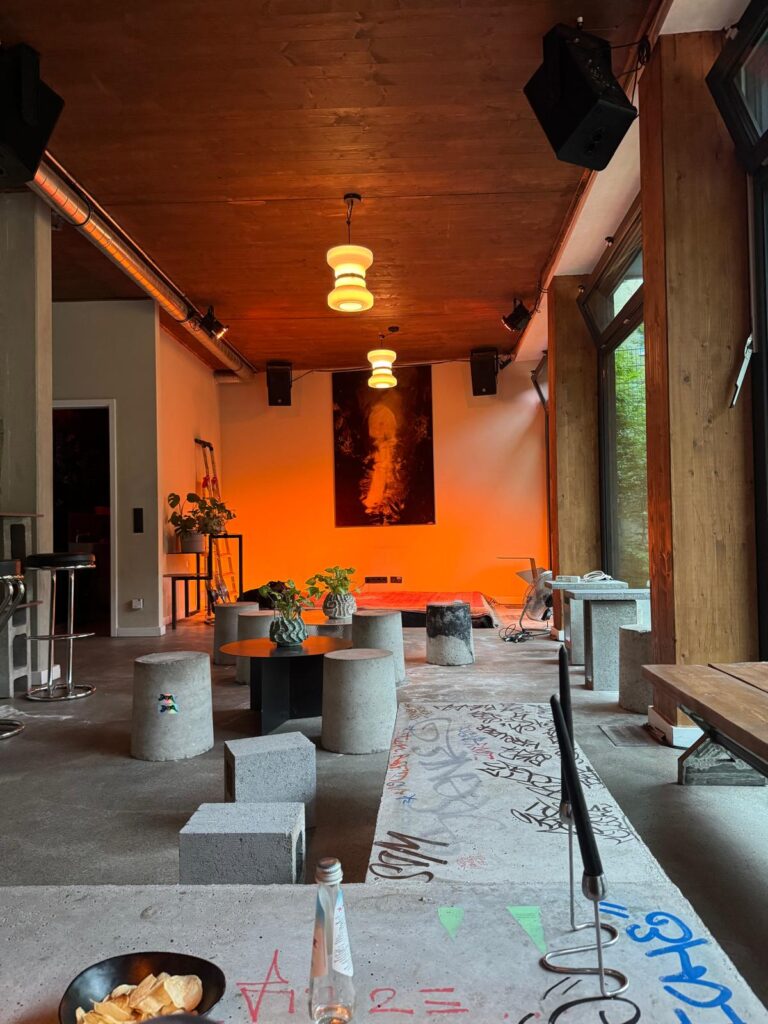
Above you can see the space the GIRI-Team created for the event. Thanks to the Team, and thanks to the very attentive audience.
Album of the Week
Alejandro Muhech – Edurne
Alejandro teamed up with Oliver Fox and a splendid rhythm section consisting of Enrique Luna and Aron Weise. The guitarists wide range of influence, stepping into the legacy of the great jazz masters, produced a recording of spectacular quality and appeal. Favourite track: Edurne.
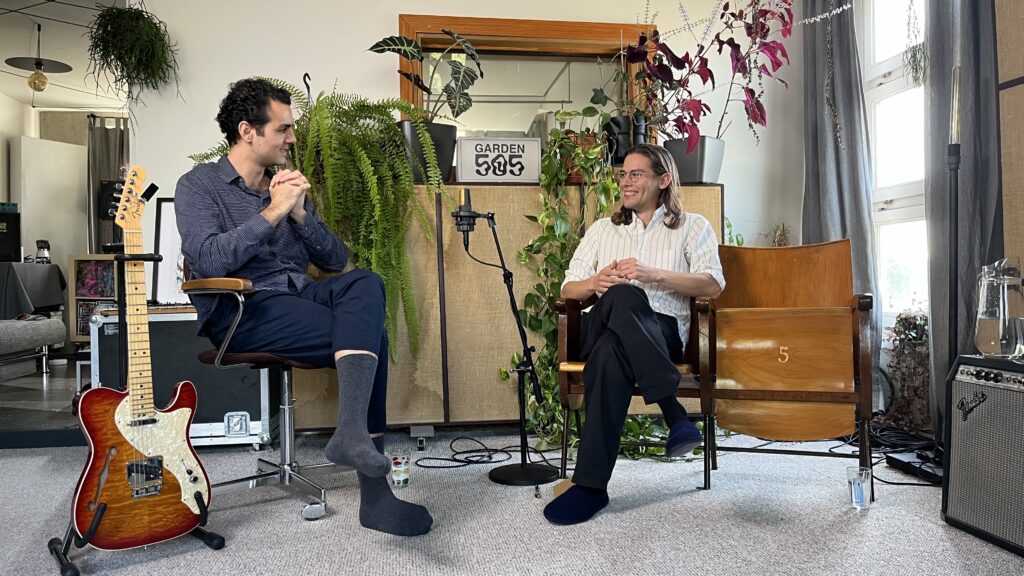
You can listen to Alejandro and my conversation soon in the first Episode of the Connection 44 Podcast!
See you soon,
Fabio
Leave a Reply